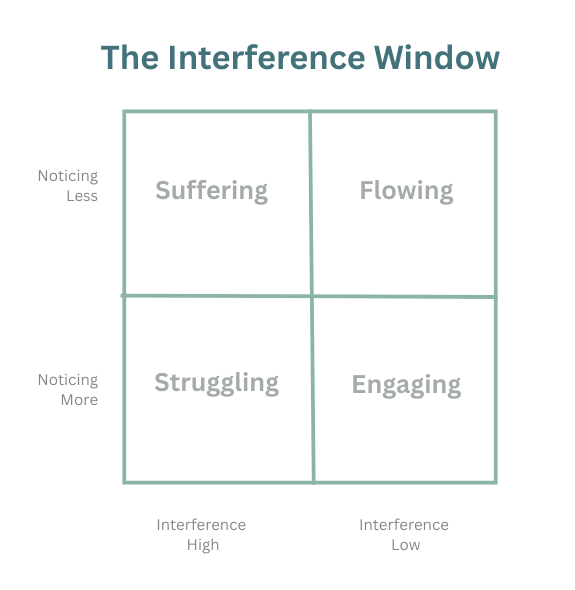
Using the Interference Window
The Interference Window is not something to practise or apply.
It’s a way of noticing what is already happening when situations feel personal, pressured, or difficult.
This page adds a little more detail for those who want it. Nothing here needs to be mastered or remembered.
What “noticing” means here
Noticing does not mean analysing or monitoring yourself.
It simply means becoming aware of what is already present, especially when effort is high or things feel personal.
This might include noticing:
the tone of your thinking rather than its content
a sense of urgency or pressure
self-referential language such as “this says something about me”
repeated thoughts about how things should be
Noticing is not something you do to thoughts.
It is something that happens around them.
Where interference tends to come from
In situations that matter, interference usually increases in two ways.
Identity gains authority
Thoughts are treated as statements about who you are, your worth, or your competence.
Resistance increases
There is an internal push against what is happening, often in the form of “this shouldn’t be happening” or “this needs to change”.
Together, these create mental noise, urgency, and reactivity.
Clarity tends to reduce, even when effort increases.
How authority loosens
Reducing interference does not involve challenging, replacing, or controlling thoughts.
Authority often loosens simply through noticing when a thought is being treated as a command, verdict, or personal truth rather than as a mental event.
This might look like realising:
“I’m arguing with this thought”
“This feels urgent, but nothing actually needs to be decided right now”
“This feels personal because identity is involved”
Nothing needs to be pushed away or resolved for authority to soften.
What usually reduces interference
Interference tends to reduce when:
thoughts and identity have less authority
there is more openness to what is actually happening
Openness does not mean liking, agreeing with, or giving up on a situation.
It simply means stopping the internal fight with experience.
When that fight eases, clarity often returns on its own.
When the Window is most useful
The Interference Window is particularly helpful when:
the situation matters
you cannot step away
effort is high but clarity is low
things feel personal or pressured
In these moments, asking “Where am I in the Window right now?” is often enough to change how much authority the experience has.
A final note
The aim is not to move to a different quadrant.
The Window reflects where things are, not where they should be.
If noticing reduces interference, clarity tends to follow.
If it doesn’t, nothing is wrong.
This is something to return to lightly, when it’s useful.